The Finish Line is in Sight — FINAL PUSH
|
You Need to Know
|
|
The finish line is in sight.
This week, lawmakers have been diligently working to advance budget bills and high-priority policies to the Governor’s desk — and signs point towards a weekend push to get it done. While no final call has yet been made, the expectation is clear: they’re staying until the season adjourns Sine Die.
What’s left? Property tax reform.
Final negotiations are front and center and lawmakers have made it clear that this was their top priority coming into session and they will not leave without delivering a bill to their constituents.
The League’s government affairs team will be at the Capitol until the final gavel. The updates below reflect where things stand as of Friday morning at 10:00 a.m.
|
League Priority Legislation |
|
Property Taxes
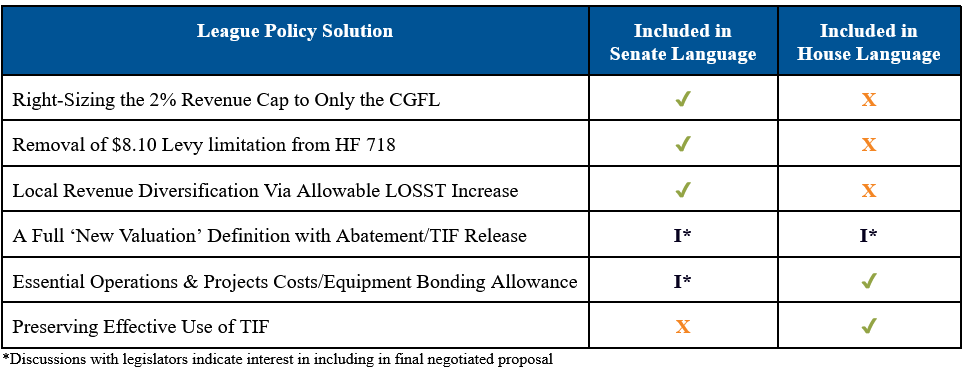
The House and Senate continue to negotiate on the framework of a property tax proposal, with the League advocating for the restoration of the Senate framework matched with the House’s TIF provisions.
Grassroots outreach from local leaders has been effective in helping lawmakers understand the unsustainable impacts of a 2% hard cap.
If you have not contacted your House member about property taxes this week, please do so today and ask them to:
-
Support a 2% cap on the CGFL only (not all levies)
-
Restore the Senate property tax framework overwhelmingly supported by both parties
-
Adopt the TIF provisions in the House property tax proposal to support economic development
Legislators are reconsidering the 2% hard cap on all levies because of the outsized & unsustainable impact they will have on Iowa’s smaller, rural communities.
Use the League’s Cost Burden Survey and, even more importantly, your own budget experience to illustrate increased costs outside of city control such as insurance, state-mandated benefits, and material/equipment prices, and ask your state legislators to adopt a proposal that truly reforms the property tax system for taxpayers and local governments.
FIND YOUR LEGISLATOR AND CALL THEM TODAY!
If you need materials to reference specific League policy solutions beyond the straightforward request above, they are found on the League website: Policy Guidance for Property Tax Reform.
|
 |
|
Sidewalk Liability | SF 2146
The League’s sidewalk liability priority bill failed to advance to the House floor, indicating that it will not pass this session. The League will continue to elevate the importance of this priority after advancing it significantly further in the legislative process this session.
|
|
|
|
|
|
|
HF 2297 | Radon Mitigation Requirement for New Residential Construction
|
|
Requires all new single-family and two-family residential construction, begun after the adoption of this regulation, to include a passive radon mitigation system as specified in appendix AF of the 2021 International Residential Code. The state building code commissioner is directed to implement this requirement through the state building code. |
|
|
|
|
SF 2378 | City Zoning Objections Process
|
|
Repeals the process by which property owners can submit a formal written protest against proposed changes to zoning districts — a protest that previously required a supermajority vote by the city council for approval. It clarifies the authority of city councils to impose reasonable conditions on property owners as part of zoning changes, provided the conditions are agreed to in writing before the public hearing.
|
|
|
|
|
SF 472 | Public Employee Collective Bargaining Retention & Recertification Elections
|
|
Revises procedures for holding retention and recertification elections for public employee bargaining units. Requires written notice to both the public employer and the bargaining representative before an election, requires the employer to submit a list of employees within ten days, and establishes a publicly available list of employers who have received notice but have not yet held an election. Non-compliance by an employer is unlawful, and Iowa residents can petition for a writ of mandamus to compel compliance, with expedited court proceedings and awards for prevailing parties. The board must extend election timelines to resolve petitions and may reschedule elections between defined periods. The board is also directed to adopt rules for these procedures.
|
|
|
|
|
SF 2218 | Required Citizenship Tests |
|
Requires all initial applicants and license renewals for educational licensure to provide evidence of legal authorization to work in the U.S. School districts, nonpublic schools, charter schools, and innovation zone schools must verify employment eligibility of all new hires, aligning with federal requirements under 8 U.S.C. §1324a. The bill specifies acceptable documentation and sets procedures for practitioners not subject to regular renewal. |
|
|
|
|
HF 2780 | “Social Districts” |
|
In addition to other provisions unrelated to cities, language supported early in session by the League was amended onto the bill granting cities the authority to create social districts by local ordinance to allow regulated public consumption of alcohol in designated areas, subject to local rules and enforcement mechanisms. |
|
|
|
|
Returns to House for Concurrence
|
|
|
|
SF 2284 | Automatic Traffic Enforcement Restrictions |
|
Restricts the sharing of images or data from automated traffic detection systems to specified parties, prohibits issuing citations based on automated vehicle noise enforcement systems for noise emitted during braking or deceleration, and enhances due process protections for vehicle owners who receive citations from automated systems. It provides procedures for contesting citations and ensures dismissal for owners not operating the vehicle at the time of the violation.
NEW AMENDMENT: Restricts the number of mobile automated traffic enforcement systems allowed to be used by cities (2-5 depending on population), as well as requiring 50% of the revenue generated from these systems be used to pay for the pensions/benefits of police and fire department employees. The remaining 50% would still be permitted for use as current law allows. |
|
|
|
|
You can view all editions of Legislative Link at iowaleague.org/resource/legislative-link.
Like our membership, the Iowa League of Cities is a non-partisan, service-oriented organization that does not participate in elections, make campaign contributions, or have a political action committee (PAC). |
|
|
|
|


