|
We anticipate several property tax proposals will be released early in the session, with separate proposals expected from the House, Senate, and Governor’s office. This is a welcomed shift and reflects feedback lawmakers heard from local governments following the 2025 session. We appreciate legislators’ recognition that advancing significant policy changes late in session, often without sufficient time for local input, created challenges. Earlier proposals allow for more thoughtful review and engagement.
Iowa House Democrats released a property tax proposal earlier this week. The League is currently awaiting bill language to project the impacts of this and future proposals from the Statehouse in order to bolster our advocacy and engagement with lawmakers.
To that end, the League is prepared to analyze proposals as they are introduced. However, we will need your help to contextualize this analysis and provide meaningful, real-world feedback to lawmakers. Local insight remains critical as these discussions unfold.
Please be prepared to review bill summaries in the coming weeks, as proposals are expected to emerge earlier than in past sessions. We also encourage members to keep an open mind as ideas are introduced. A bill is simply a first draft - nothing is final, and as we experienced last year, constructive input early in the process can meaningfully shape outcomes.
As part of these conversations, the League is emphasizing several key principles with lawmakers, including:
-
One-size-fits-all solutions affect communities very differently, making time for modeling and impact analysis essential.
-
New construction and development should be excluded from any revenue restrictions under consideration.
-
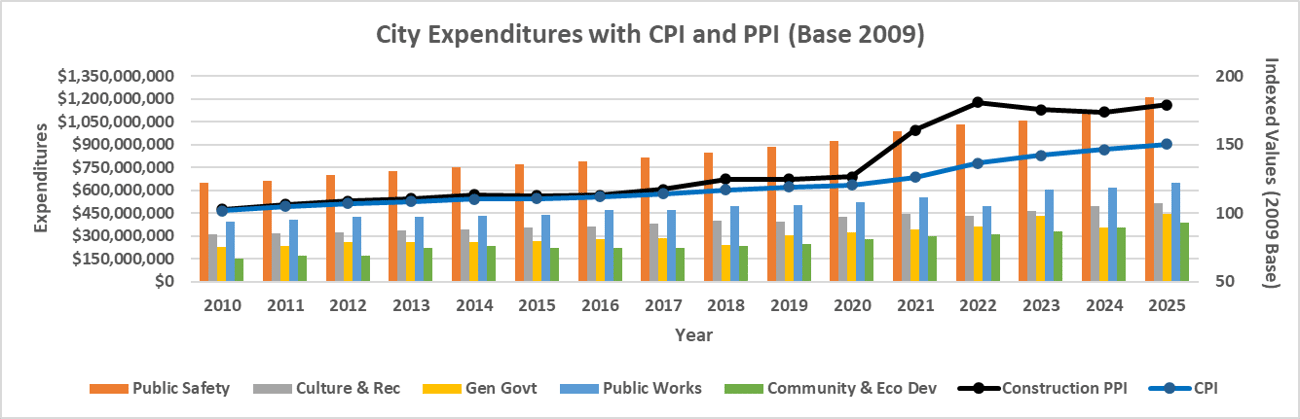
Any revenue limitation should be paired with an inflationary index to reflect the economic realities cities face. The costs for cities to provide services to residents, as shown by the Producer Price Index (PPI) have increased at an even higher rate than other inflationary metrics like the Consumer Price Index (CPI). Arbitrary caps do not account for rising costs that, like household expenses, arrive month after month.
|