|
Please Run the Financial Impact Analysis Model for Property Tax Reform
|
|
The League is asking city officials to download and use the 2026 Property Tax Reform Model to assess how the proposals could affect their communities. Your feedback is critical. The more real-world local data we can provide to legislators, the stronger our ability to advocate for practical, workable policy solutions.
Please run this easy-to-use model, developed by the League’s Partner, Piper Sandler & Co., as soon as possible. Conversations are happening this week, so the sooner you can have a conversation with your lawmaker the better. |
|
View Model, Explainer, and Resources
|
|
|
|
|
|
|
The Ask |
|
The model is intended to inform your conversations with lawmakers. As you engage, use your results to help explain what these proposals mean for your city in practice, including how they may affect your ability to plan, budget and deliver services over time. It is important to look beyond any single-year impacts.
Rather than simply sharing model outputs, we encourage you to use this tool to develop a clear understanding of how each proposal affects your community and to communicate those impacts in your own words.
After reviewing your results, please share your key takeaways and insights with your House and Senate lawmakers, as well as with the League at legislativestaff@iowaleague.org. Please reach out with any questions.
The message we are asking you to deliver is simple:
1. Let's work together
2. Cities want to be able to sustain the property tax relief delivered by the legislature
3. In order to sustain that relief, cities are bringing forward the following policy solutions that need to be incorporated into a final bill agreed to by the House and Senate.
|
|
|
|
Right-Sizing the 2% Cap
|
|
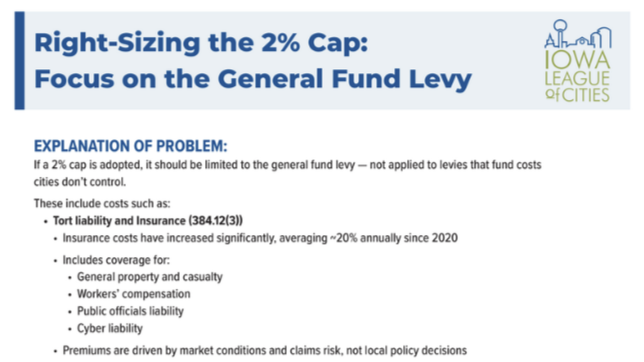
If a 2% revenue cap is adopted, it belongs on the general fund levy -- not on levies that pay for costs that cities don't control. Tort liability, insurance costs and benefits obligations are outside of a city's control, but would quickly eat through a budget under a 2% cap on all levies. Insurance costs alone have increased ~20% annually since 2020. |
|
|
|
|
Essential Operations and Equipment Bonding
|
|
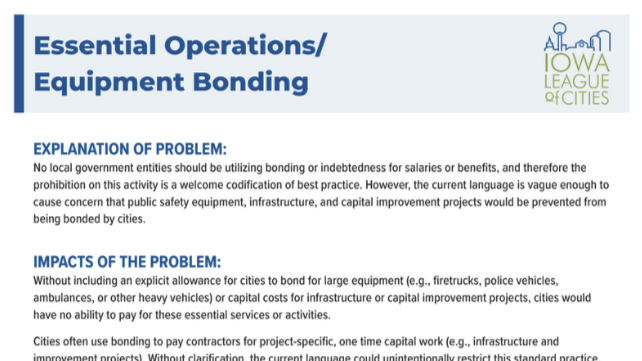
No local government entities should be utilizing bonding or indebtedness for salaries or benefits, and therefore the prohibition on this activity is a welcome codification of best practice. However, the current language is vague enough to cause concern that public safety equipment, infrastructure, and capital improvement projects would be prevented from being bonded by cities. |
|
|
|
|
New Valuation |
|
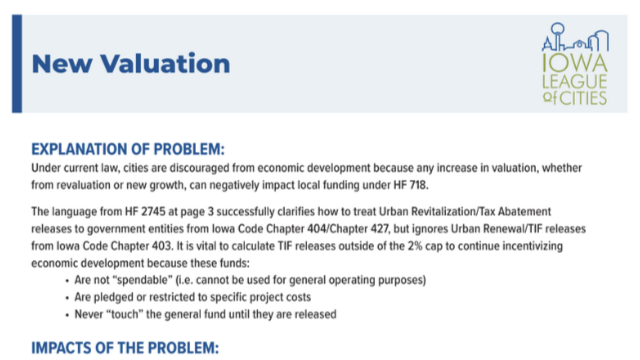
Under current law, cities are discouraged from economic development because any increase in valuation — whether from revaluation or new growth — can negatively impact revenues under HF 718. |
|
|
|
|
Local Options Sales and Service Tax |
|
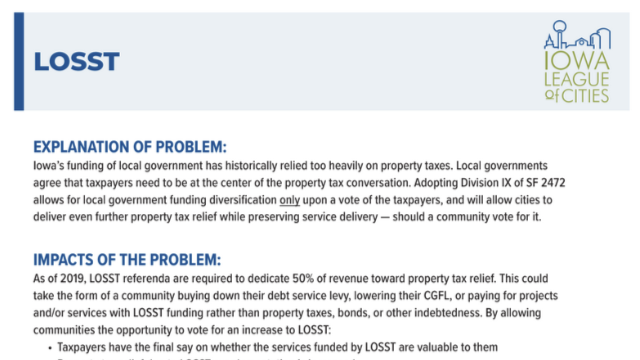
Iowa’s funding of local government has historically relied too heavily on property taxes. Local governments agree that taxpayers need to be at the center of the property tax conversation. Adopting Division IX of SF 2472 allows for local government funding diversification only upon a vote of the taxpayers, and will allow cities to deliver even further property tax relief while preserving service delivery should a community vote for it.
|
|
|
|
|
Property Tax Reform Bills
|
|
Since the beginning of session, there have been three prominent property tax reform proposals up for discussion. Last week, the House adopted an amendment incorporating several provisions from the Governor’s proposal, signaling a possible path toward compromise between those two bodies.
At this stage, HF 2745 (the House bill) and SF 2472 (the Senate bill) are the primary bills under consideration by the Iowa Legislature. While the model also includes the Governor’s proposal for comparison purposes, the House and Senate bills are the active legislative vehicles currently moving through the process.
These proposals would make significant changes to Iowa’s property tax system. Although the bills differ in structure and approach, they share similar stated goals: reforming the system and delivering property tax relief to Iowans. As negotiations continue, the Iowa League of Cities is actively engaging with lawmakers to offer targeted policy solutions that improve the legislation and help shape any final agreement.
We expect additional revisions to these proposals as lawmakers continue negotiations and respond to stakeholder feedback. Your city’s information will help policymakers better understand how the current proposals could affect municipal operations, budgeting, and the delivery of essential local services.
|
|
|
|
|
The League is grateful to Piper Sandler & Co. for developing this tool and providing their expertise in support of Iowa cities. Their partnership has made it possible to deliver this resource to members at no cost. |
|
|
|
|